
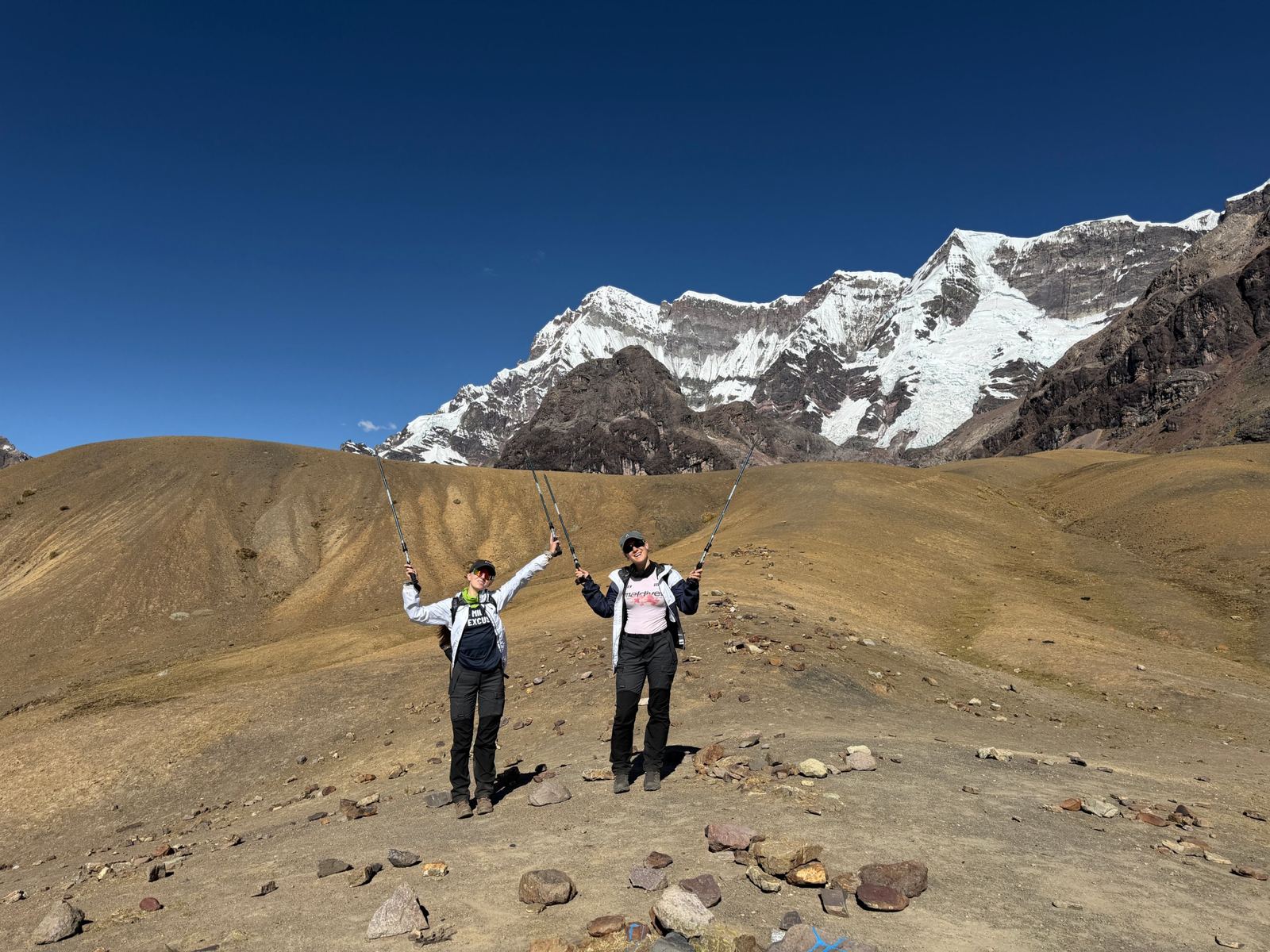
Reviewed by Edwin Curahuasi, lead trekking guide at Andean Trekking Peru. Last updated: 26 October 2026.
Quick answer
Choose Salkantay if you want to finish at Machu Picchu and see the most variety in five days. Choose Ausangate if you want remote glaciers, turquoise lakes and Rainbow Mountain without the crowds, and you are ready to sleep above 4,400 m every night.
Both are 5-day camping treks of about 70 km from Cusco. Ausangate is the harder of the two: its highest pass is about 600 m higher than the Salkantay pass, and it stays high for the whole trek. Salkantay has one very hard day, then drops into warm cloud forest.
Ausangate vs Salkantay at a glance
| Ausangate trek | Salkantay trek | |
|---|---|---|
| Days | 5 days, 4 nights | 5 days, 4 nights |
| Distance | About 69 km | About 70 km |
| Highest point | Palomani Pass, about 5,200 m | Salkantay Pass, about 4,600 m |
| Where you sleep | Every night between about 4,400 and 4,700 m | From about 3,900 m down to Santa Teresa (1,500 m), last night in a hotel in Aguas Calientes |
| Ends at Machu Picchu? | No, you return to Cusco | Yes, on day 5 |
| Highlights | Ausangate glaciers (6,384 m), glacial lakes, Rainbow Mountain at sunrise, Pacchanta hot springs | Humantay Lake, Salkantay peak (6,271 m), cloud forest, Machu Picchu |
| Crowds | Few trekkers, except at Rainbow Mountain | Busier, especially at Humantay Lake |
| Difficulty | Hard | Moderate to hard |
| Our price | From USD 699 | From USD 669 |
Figures are for our own 5-day itineraries. Other operators’ routes vary by a few kilometres and camps.
Altitude and difficulty
Altitude is the biggest difference between the two treks, and the main reason Ausangate feels harder.
- Ausangate stays high. You start at Upis (about 4,400 m) on day 1 and cross several passes around 5,000 m, including Palomani at about 5,200 m. Every camp is above 4,400 m, so freezing nights are normal, and you get little chance to recover between hard days.
- Salkantay has one big climb. You sleep at Soraypampa (about 3,900 m), cross the Salkantay pass (about 4,600 m) on day 2, then descend all afternoon. By day 3 you are in warm cloud forest, and sleep at Santa Teresa (1,500 m).
Whichever you choose, spend at least two or three days in Cusco first to acclimatize. Here is how acclimatization to high altitude works. For the climb itself, see our guide to the Salkantay pass elevation and distance.

Scenery: glaciers and lakes, or mountains to cloud forest
Ausangate circles the 6,384 m Ausangate massif. You walk past hanging glaciers and turquoise lakes such as Pucacocha, through alpaca herding country with almost no roads. On our 5-day trek you reach Rainbow Mountain (Vinicunca) at sunrise from the quiet back side, before the day-trip crowds arrive, and finish at the Pacchanta hot springs. Read more in our guide to Ausangate trekking and the Ausangate 7 lakes.
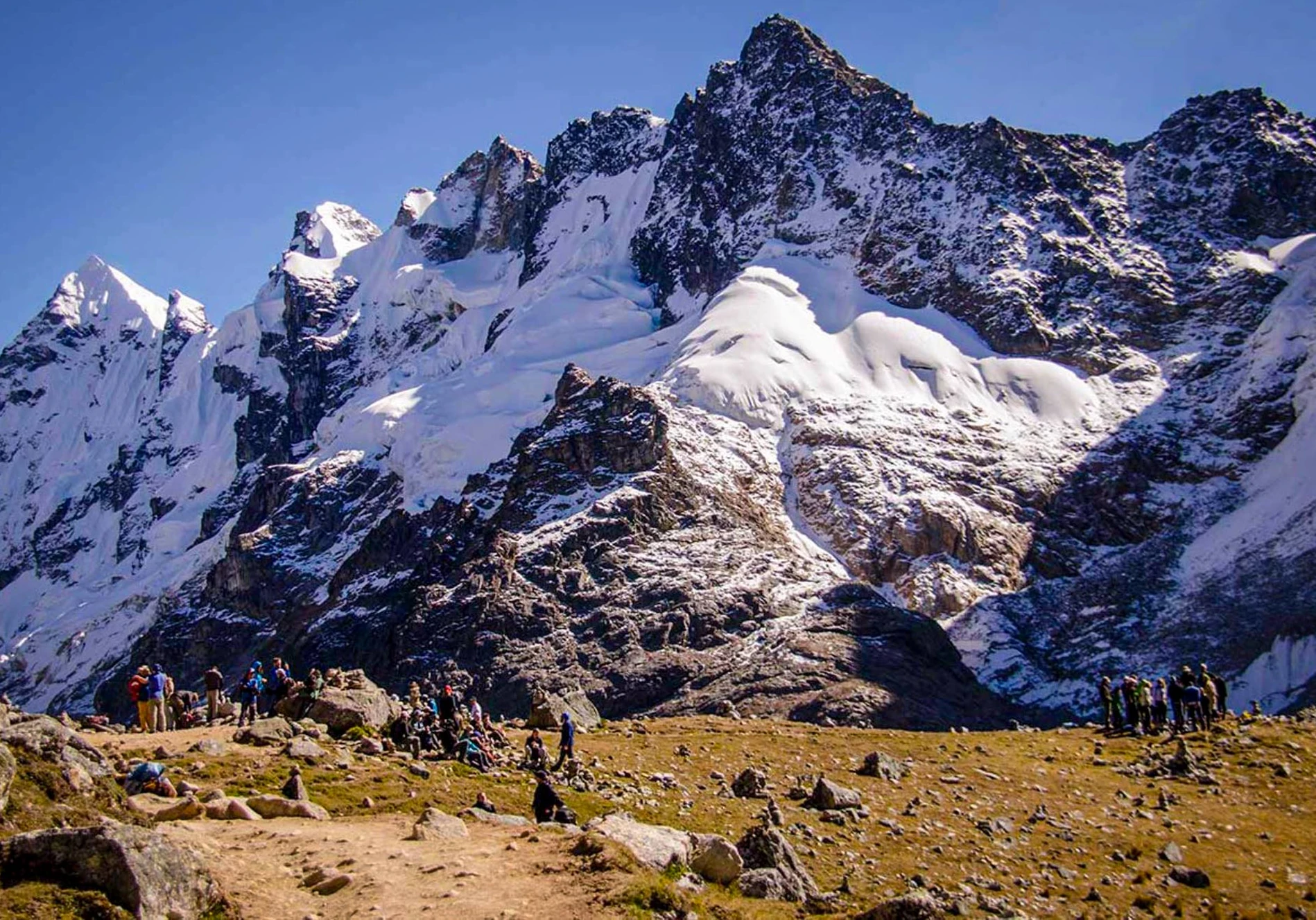
Salkantay changes every day. Day 1 takes you to Humantay Lake below the Humantay glacier. Day 2 crosses the pass right under Salkantay (6,271 m). Then you drop into cloud forest and coffee country, soak in the Cocalmayo hot springs near Santa Teresa, and end the trek at Machu Picchu.
Crowds, permits and Machu Picchu
- No Inca Trail permit is needed for either trek, so you can book them later than the Inca Trail. If you have your heart set on the Inca Trail, see Inca Trail Permits 2027.
- Salkantay is busier. It is the most popular alternative to the Inca Trail, and Humantay Lake is also a busy day trip from Cusco, so you will share the trail and camps with other groups.
- Ausangate is quiet. You may walk for hours without seeing another group. The exception is Rainbow Mountain, which receives around 1,500 visitors a day in peak season.
- Machu Picchu: Salkantay ends there, and our tour includes the entrance ticket and the train back. Ausangate does not go to Machu Picchu, so you need to add it as a separate trip.

Camps, food and comfort
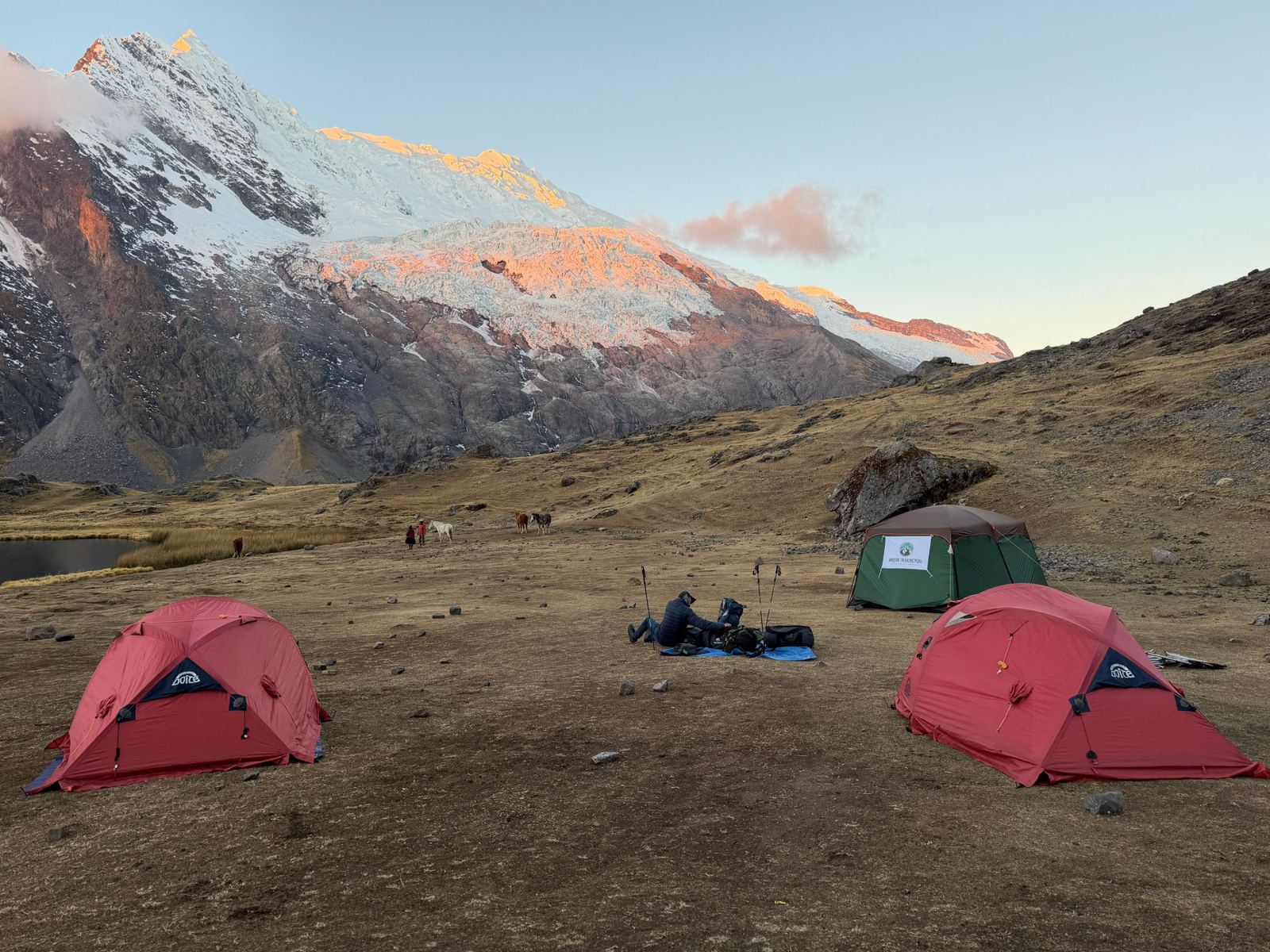
Both treks are fully supported: a cook prepares all meals, and horses or mules carry the camping gear and your duffel bag, so you walk with a daypack. On our Ausangate trek you sleep in four-season tents, apart from private cabins at Upis on the first night. On our Salkantay trek you camp for two nights, sleep in Santa Teresa on night three and in a hotel in Aguas Calientes on the last night.
The main comfort difference is temperature. Ausangate camps are cold every night, so bring a sleeping bag rated well below freezing. Salkantay is cold only on the first two nights.
When to go
The best months for both treks are May to September, the dry season. In the rainy season, roughly November to March, Ausangate passes can get snow, and the road to Soraypampa has been closed by landslides more than once: access to Humantay Lake was suspended in March 2025 and again in early 2026. If you are travelling in the wet months, read which Cusco treks still work in the rainy season.
Which trek is right for you?
Choose Ausangate if:
- you have trekked at altitude before, or have time to acclimatize well
- you want wild mountain scenery and few other trekkers
- you want to see Rainbow Mountain without the crowds
- you are visiting Machu Picchu on a separate trip
Choose Salkantay if:
- this is your first multi-day trek at altitude
- you want to end your trek at Machu Picchu
- you like variety, from glaciers to cloud forest
- you could not get an Inca Trail permit
Book either trek with Andean Trekking Peru
- Ausangate Trek 5 days: the full circuit with Rainbow Mountain, from USD 699.
- Ausangate and Rainbow Mountain 3 days: a shorter taste of Ausangate, from USD 465.
- Salkantay and Humantay Trek 5 days: ending at Machu Picchu, from USD 669.
- Salkantay and Inca Trail 6 days: Salkantay plus a section of the Inca Trail into Machu Picchu.
Not sure which suits you? Tell us about your fitness and dates or message us on WhatsApp, and our guides will help you choose.
Ausangate vs Salkantay: frequently asked questions
Ausangate. Its highest pass, Palomani, is about 5,200 m against about 4,600 m on Salkantay, every camp is above 4,400 m, and the hard days come back to back. Salkantay has one very hard day, then descends into the cloud forest.
Yes. Most 5-day Salkantay treks, including ours, end with a guided visit to Machu Picchu on the last day and the train back towards Cusco. The Ausangate trek returns to Cusco without visiting Machu Picchu.
Yes. Our 5-day Ausangate trek reaches Rainbow Mountain (Vinicunca) at sunrise on day 3, before the day-trip crowds. Our 3-day Ausangate and Rainbow Mountain trek also includes it.
Neither trek needs an Inca Trail permit. Salkantay needs a Machu Picchu entrance ticket, and Ausangate has park and community entrance fees. Both are included in our tours.
Salkantay, if you are fit and have acclimatized in Cusco for two or three days. Ausangate is better suited to hikers who have already trekked at high altitude.
May to September, the dry season. From November to March expect rain, snow on the high passes and occasional landslides on the road to Salkantay.


