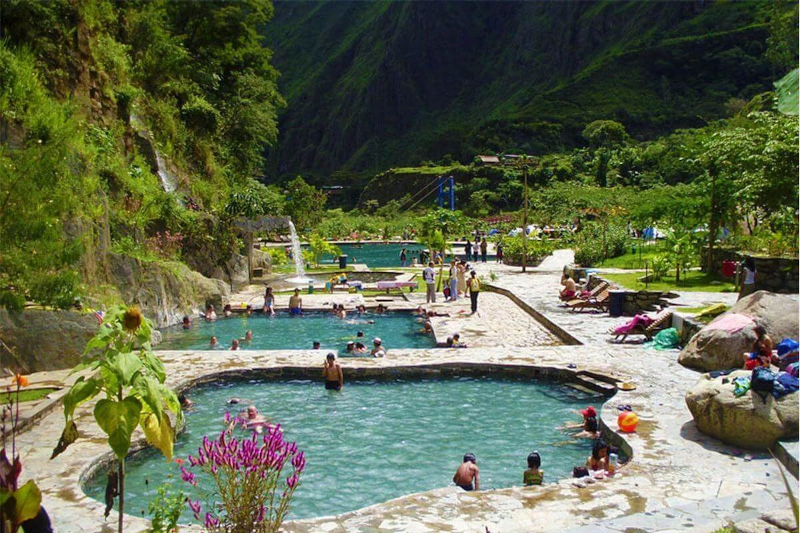
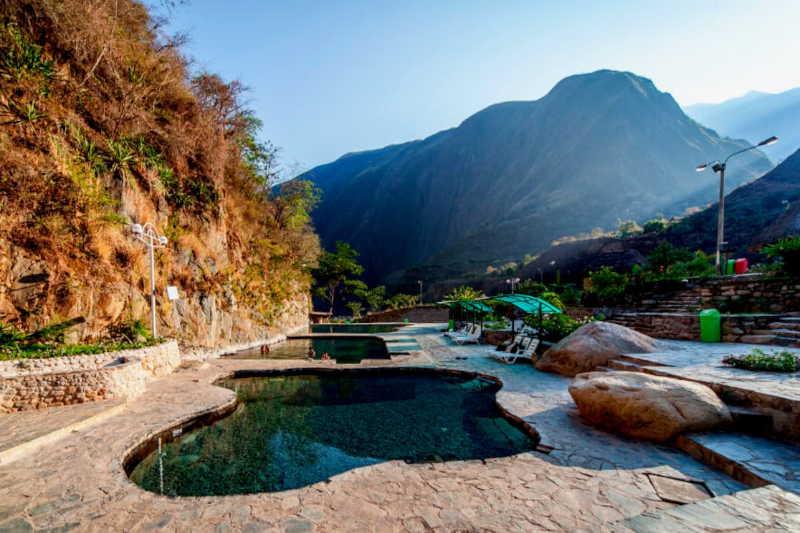
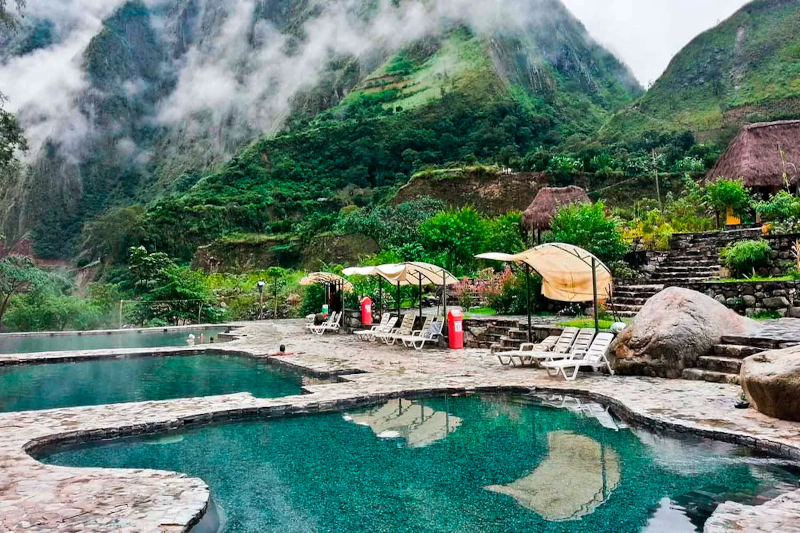
You’ve been on a hike for a while and feel like you’ve got some nice knocking around bricks in your legs? You have walked a long distance and your legs feel like they’ve been ‘polished’ to bricks? Imagine yourself walking in the high jungle of Peru, around a corner, as the Urubamba River splashes below where, hanging on the hillside, you can see three steaming pools situated within a green valley. This is The Cocalmayo Hot Springs, (or Santa Teresa Hot Springs), one that is worth the bus trip.

One small heads-up: Cocalmayo feels “off the main track,” but it’s not remote in a scary way. It’s organized, easy to use, and very used to travelers showing up dusty, hungry, and grinning.
First, the water. It’s clear. Not “clear enough,” but genuinely clear—like you can see your feet and the pool floor. Many of the hot springs around the Andes are more sulfurous and tend to be cloudy or yellow in color. The pools of Cocalmayo are the result of the geothermal water and all structures have been built in this way so that the experience is normal and not as if a concrete bathtub was dropped in the jungle.
Second, the vibe. The setting is lush and loud: birds, river noise, jungle air that feels warm even at night. You dip in, you hear, you forget to check your e-mail. Plus, if you are traveling with friends it’s one of those places where it’s an opportunity to slow them down for a minute while you are in town.
Water temps usually sit around 38°C to 44°C (about 100°F to 111°F). Translation: warm enough to relax your shoulders, hot enough that you’ll want breaks. And yes, the mineral content matters. People talk about these waters helping with sore muscles, circulation, and skin irritation. Is it a clinical treatment plan? No. But does it feel like your body is saying “thank you”? Pretty often, yeah.

Cocalmayo is located approximately 4 km (2.5 mi) from the town of Santa Teresa, Peru on the jungle side of Cusco. Santa Teresa is a typical trail town—easygoing, welcoming, hiker-filled, vendors of snacks — yummy when exhausted.
It’s also a functional platform. It will fit into the logistical plans of those undertaking the more alternative routes to Machu Picchu: Inca Jungle Trail, elements of the Salkantay area, etc. Putting it into project-management terminology, it’s more of a “staging area” than the deliverable itself; just an important link in the chain in moving a process from one point to another.
The majority of visitors come to Cocalmayo via the Valley’s transport hub of Hidroelectrica. Cusco is connected with minibus to wind through the mountains (deals are usually booked via the various agencies), over a high pass, and into the cloud forest. It’s scenic. If you get cars sick, it’s a bit too much too, bring ginger chews and/or Dramamine with you.
Coletivo (shared taxi) or private taxi is the usual mode of transport from Hidroelectrica to Santa Teresa which are usually quite short distances. From Santa Teresa then it’s a short hop back to the springs on a horse ride—or another short ride on a taxi, it all depends on how active you are and what the weather is like.
Coming from Aguas Calientes (Machu Picchu Pueblo)? There are trains to/re from Hidroelectrica or it can be walked over the railway route (a popular implicit path). Then it’s the same taxi connection toward Santa Teresa. It sounds like a lot written out, but on the ground it’s basically: get to Hidroelectrica, then get to Santa Teresa, then get to Cocalmayo.
One tiny digression that matters: keep some cash in small bills. Not because it’s risky—because it’s practical. The “last mile” of travel in Peru is often paid in cash, and nobody wants to be the person trying to break a big note while everyone waits.
Cocalmayo has a reputation as the sweet finish after hard routes. And it earns it.
Everyone who has ridden the Inca Jungle Trail must have combined several aspects of sport – maybe just biking, maybe just hiking, maybe rafting – or have sampled some of it all. It’s fun. It’s also a lot on the body. Sliding into a hot pool afterward feels like the world’s simplest recovery protocol.
For the Salkantay crowd (or anyone doing long days on uneven steps), the springs work as a “reset.” Here’s what tends to help most:
And here’s a mild contradiction: sometimes the best move after a trek is not a hot soak. If you’re swollen, overheated, or you feel dizzy, cool down first. Sit. Eat. Let your heart rate settle. Then soak. The springs will still be there, and you’ll enjoy them more.
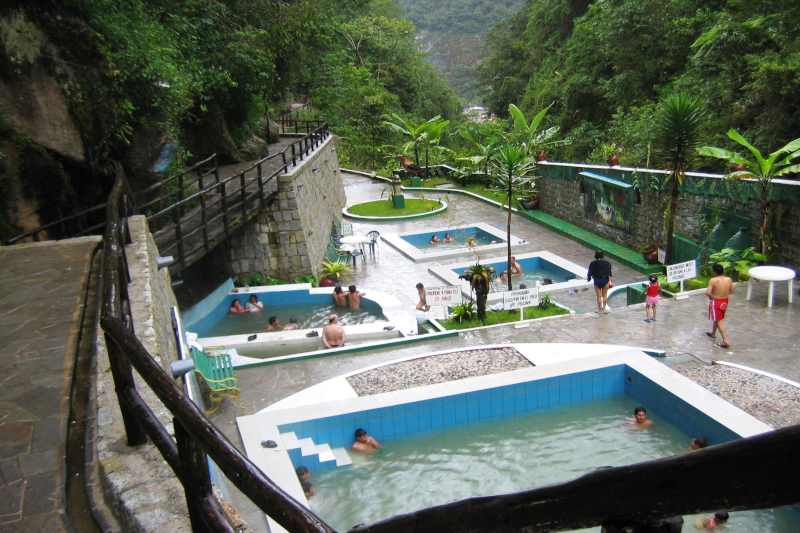
If you’ve heard of the Aguas Calientes hot springs, you’ve probably also heard opinions. Strong opinions. The Aguas Calientes baths are convenient—walkable, easy, right at the base of Machu Picchu. That convenience is real.

But Cocalmayo tends to win on the actual soaking experience. The pools are bigger, the environment is more open and water is more inviting. Not to mention a resurgence of that “we found something special” feeling, although I don’t know how it feels when it’s not so secretive.
If you have a hard time finding time, Aguas Calientes might be all you can do and it’s ok. When there’s a little breathing room, it is typically Cocalmayo that gets all the post-hate.
The roads will be easier to travel and the skies are usually clearer during the dry season (roughly May-October). From a risk management point of view that’s the most reliable course.
But the rainy season is its beauty too. Hot water when it rains cool on your shoulders? It’s weirdly comforting. Just be aware that the shoes will get muddy and walking will be slightly slower. This is the time if you are like the type of people who take their mobile with a lot of weather applications.
Time of day matters, too. Early morning is calm. Late afternoon can be beautiful. Night is its own thing—quiet, steamy, and a little magical.
It’s a popular question and it’s a valid one. Cocalmayo is usually organized for night activities: In addition to being lighted and staffed, it can often be very family-oriented and relaxed. Take common sense steps: keep valuables simple; don’t go off on your own and into a dark place, you will likely feel comfortable.
Also, night is when you notice the soundscape. The river is louder. The jungle feels closer. And you might catch yourself thinking, “How is this real?”
Generally it is not too expensive going in ($10 or 15 soles, about $3 or 4 USD, is the usual price, but it varies); that said, it may be worth checking prices in advance. Vending machines are available at kiosks. No fancy spa menu – just some quality inexpensive fuel to enjoy after an all day ordeal.
Simple facilities include changing areas, toilets, showers. It is not fancy, but that’s a part of the attraction. It works. It’s clean enough. What you hear is what you get!
Budget hostels, guesthouses and eco style lodges are located at Santa Teresa. If you enjoy a hot shower, and a good mattress, then stay in town and check out the springs whenever you want.
For those who want to escape indoors, camping is just around the corner at the complex, too. Getting up and getting in at the early hour before the rush of the day to warm up in the hot water? It’s a compelling reason. It’s one of those moments in your travels that you will cherish: easy, peaceful, sweet.
The Cusco region is like two climates in one tour: cold mountains and warm forest (jungle). Pack as though you’re moving in the middle of the project – which you are.

One more casual note: if you’re on a long trip, hot springs can be the “reset day” that helps your mood as much as your muscles. Travel is fun, sure—but it’s also decision fatigue, constant planning, and the occasional low-grade frustration. A soak can smooth that out.
If you’ve got a half day, don’t rush off immediately. The Urubamba River runs right there, and it’s dramatic—fast water, big rocks, jungle everywhere. Even a short walk changes the pace from “tourist stop” to “wow, nature is loud.”
Coffee is another trademark of Santa Teresa. Enjoy fresh in a manner most don’t experience at home coffee, visit local farms, and an understanding of the bean processing. It’s a welcome diversion to the Machu Picchu story, except for the dramatic setting, the rhythm is completely different.Even if you still have any energy (who are you?), the routes are also available with a zip-line above the valley. It’s a jolt of adrenaline and it makes everything seem to snap into place, the river, mountains, jungle, and the road you travel on. It’s like making a map but in reality!
Yes—especially if you’ve been hiking, biking, or bouncing around the Cusco region on a packed schedule. Cocalmayo is a warm pause in the middle of big travel days. It’s soothing without being precious. It’s easy without being boring.
And maybe that’s why people love it: you don’t have to “do” anything. You show up. You soak. You breathe. Then you climb out, feeling a little more human again—ready for the next bus, the next trail, the next early alarm. Because Peru will keep asking a lot from you. Cocalmayo gives a little back.